
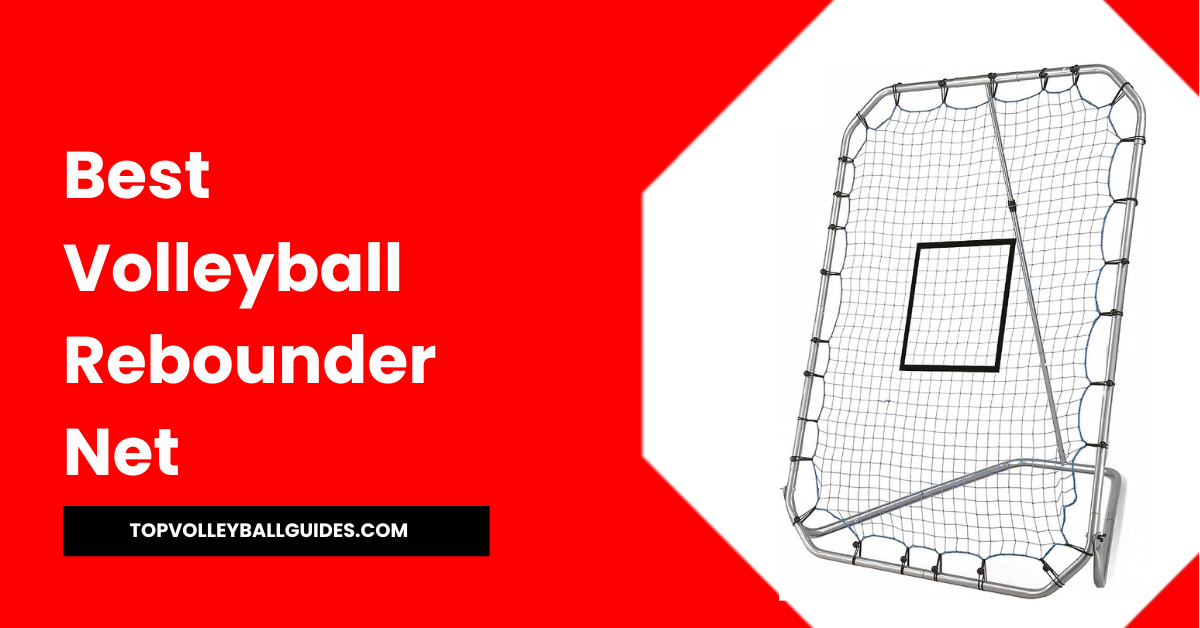
Training in volleyball isn’t just about team practice—it’s also about putting in the work on your own. That’s where a volleyball rebounder net comes in handy. These nets bounce the ball back to you so you can practice serving, setting, spiking, or passing without needing a partner. Whether you’re a beginner looking to sharpen your skills or an advanced player fine-tuning your technique, the right rebounder can make all the difference. Below, we’ll break down some of the 15 best volleyball rebounder nets you can buy, including their features, performance, and honest reviews.
Affiliate Disclosure: This post contains affiliate links. If you buy through these links, we may earn a small commission at no extra cost to you. This helps us keep creating free volleyball guides and honest reviews.
Quick Comparison: The 15 Best Volleyball Rebounder Nets
| Product | Best For | Key Feature |
| Lacrosse Rebounder Net | Best Large Surface | Adjustable angles, multi-sport frame |
| Kixer Rebounder Net | Best Budget | Compact, fast elastic return |
| Aceletiqs Volleyball Rebounder | Best Adjustable | Folding steel frame, multi-angle surface |
| Olybeaka Volleyball Rebounder | Best Value | 6 angles, includes ball, pump and stakes |
| Franklin Volleyball Rebounder | Best for Beginners | Lightweight, weather-resistant net |
| Seenelling Adjustable Rebounder | Best Adjustable Design | Adjustable angles for solo training |
| ZVFOTN Volleyball Rebounder Net | Best Overall | All-round size, tension and build |
| Winthai Rebounder Net | Best Multi-Sport | Works across sports and drills |
| Newbyinn Volleyball Rebounder | Best for Young Players | Beginner-friendly setup |
| WARMOUNTS 2-in-1 Rebounder Net | Best 2-in-1 Versatility | Two training modes in one frame |
| Suteck Volleyball Rebounder Net | Best Durability | Heavy-duty build |
| Oswerpon Volleyball Rebounder Net | Best for Heavy Use | Built for hard daily training |
| BAGAIL Volleyball Rebounder Net | Best Value Kit | Complete kit at a value price |
| SKLZ Volleyball Rebounder | Best for Solo Training | Trusted training-brand design |
| Ovanto Spike Solo Trainer | Best for Spiking | Solo spike-practice design |
1. Lacrosse Rebounder Net — Best Large Surface

Yes, it is built for lacrosse — and that is exactly why volleyball players like it: a big, high-tension surface with adjustable angles and a sturdy, weather-coated steel frame. The wide target forgives off-target passes, so solo sessions flow instead of turning into ball-chasing.
Returns stay consistent for passing, setting and controlled serves, and changing the angle simulates different game situations. The honest costs: it is heavier than volleyball-specific rebounders and needs more storage space. If you train multiple sports, or simply want the biggest target on this list, it earns its place.
Key Features
- Large surface area with high-tension net
- Adjustable angles for versatile drills
- Sturdy steel frame with weather-resistant coating
- Designed for both volleyball and lacrosse training
Best For: Best for multi-sport athletes and players who want the largest rebound surface for solo practice.
Our Verdict: The big-target pick — maximum surface, multi-sport value.
- Large surface area reduces errors
- Multi-sport functionality
- Adjustable angles for skill variety
- Heavier than smaller rebounders
- Requires more storage space
2. Kixer Rebounder Net — Best Budget

The Kixer is the budget-friendly way to start solo training: compact, lightweight, and fitted with an elastic net that fires the ball back quickly for reflex and accuracy work. It folds away easily, so it suits apartments, garages and travel.
The trade-off is size — the smaller surface demands better accuracy (arguably good training), and it is not built for heavy spiking. For passing, setting and controlled serving at a starter price, it delivers exactly what beginners and casual players need.
Key Features
- Compact and portable design
- High-quality elastic net for quick ball returns
- Lightweight yet durable frame
- Easy to assemble and fold for storage
Best For: Best for budget-conscious players who want portable solo practice anywhere.
Our Verdict: The budget pick — small, fast and easy to live with.
- Easy setup and storage
- Quick ball return for fast-paced drills
- Lightweight and portable
- Smaller surface area
- Less durable for heavy spiking practice
3. Aceletiqs Volleyball Rebounder — Best Adjustable

Aceletiqs is the name most volleyball players search for in this category, and for good reason: an adjustable rebound surface on a steel, anti-rust frame that folds flat for storage. Change the angle and the same unit trains defense, passing and serving.
It balances price, portability and function better than most — good for solo work and small-group sessions alike. Hard spikes can shift it slightly, and it is not pro-size, but as an all-round home trainer it is the one most players end up happy with.
Key Features
- Adjustable rebound surface
- Steel frame with anti-rust coating
- Foldable for storage
- Designed for multiple drills
Best For: Best for players who want one adjustable rebounder for every drill.
Our Verdict: The adjustable all-rounder — the category’s benchmark.
- Easy to fold and store
- Reasonable price
- Adjustable for different skills
- Can move slightly on hard spikes
- Not as large as pro rebounders
4. Olybeaka Volleyball Rebounder — Best Value
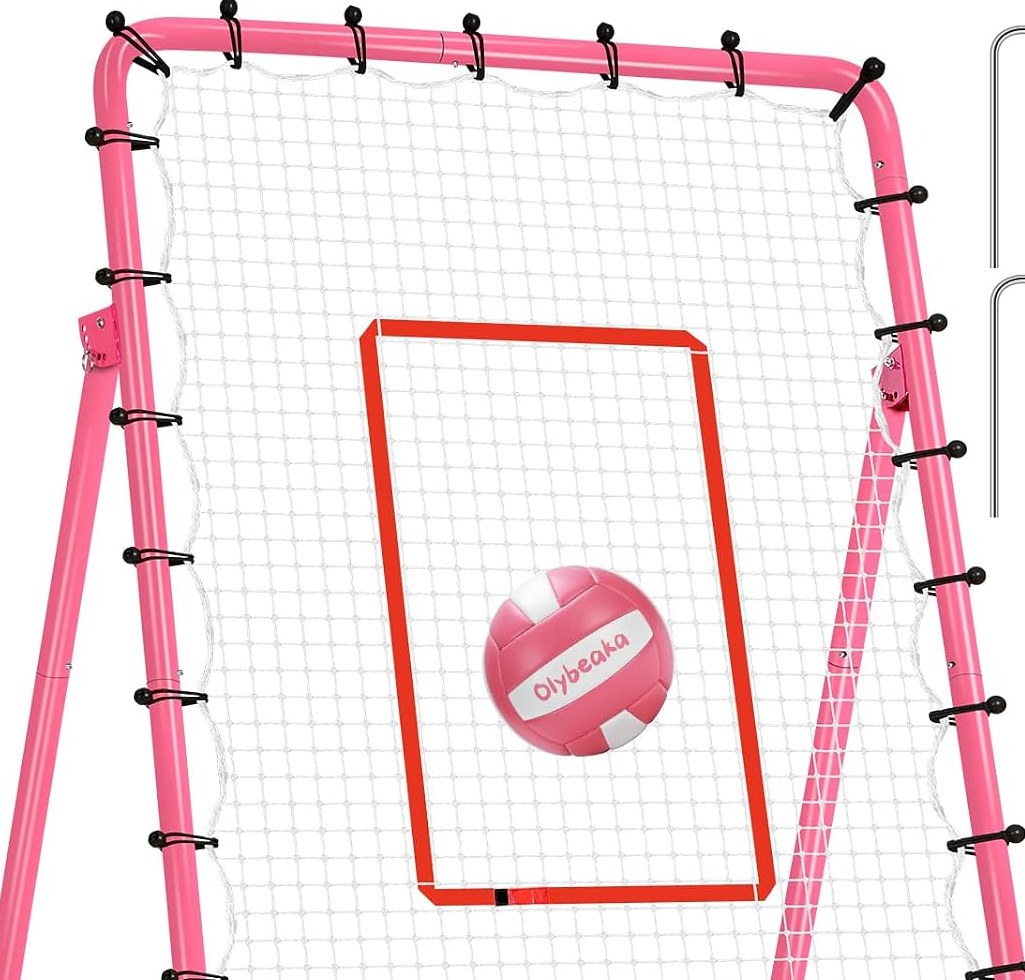
The Olybeaka is the value play of this list: the same full 7×4 ft frame and 28 square feet of rebound surface as the premium nets, but with six adjustable angles instead of the usual five — and a box that already includes a PU volleyball, a pump and ground stakes. Its 4.6-star average across 300-plus reviews shows buyers are not just saving money; they are happy with what arrives.
The alloy steel frame and high-tension net cover the full drill list — passing, setting, spiking — and the red target zone on the net gives solo sessions a proper aiming point. The brand is newer than the big names here, so its long-term track record is shorter, but for a first rebounder or a family setup, nothing else in this list gives you this much kit for the money.
Key Features
- 7×4 ft frame — 28 sq ft rebound surface
- 6 adjustable angles, one more than most nets
- Includes PU volleyball, pump and ground stakes
- Red target zone for accuracy drills
Best For: Best for first-time buyers and families who want a complete training kit in one box.
Our Verdict: The most kit for the money — six angles and everything included.
- Six angles, one more than the category standard
- Volleyball, pump and ground stakes all included
- Full 28 sq ft surface at a budget-friendly price
- Strong 4.6-star rating from 300+ reviews
- Newer brand, so long-term durability is less proven
- Fewer reviews than the category's best sellers
5. Franklin Volleyball Rebounder — Best for Beginners

Franklin’s mid-sized rebounder is the friendly starting point: a lightweight frame, adjustable angles, weather-resistant netting, and a price that does not punish a new hobby. Assembly is quick, and it is easy for kids to use safely.
It will not challenge advanced players — the smaller surface limits high-level drills, and strong hitters will outgrow it. But for youth players and beginners building passing and serving basics, it gives reliable reps at the right price.
Key Features
- Mid-sized rebounder net
- Lightweight frame for portability
- Adjustable angles for different skills
- Weather-resistant netting
Best For: Best for beginners, kids and families starting volleyball training at home.
Our Verdict: The starter pick — simple, light and priced for beginners.
- Portable and lightweight
- Easy to assemble
- Affordable price
- Good for youth training
- Smaller size limits advanced drills
- Not ideal for strong hitters
6. Seenelling Portable Rebounder — Best Adjustable Design

The Seenelling is the rebounder volleyball players keep discovering through the baseball aisle: a compact 3 x 3 ft pitch-back with three adjustable angles, a heavy-duty net, and a kit — storage bag, carrying strap and four ground stakes — that makes it genuinely portable. Set it low for digging reps, mid for passing, high for setting: the same session structure players use on far bigger rebounders.
Be clear about what it is: the small surface rewards accuracy and punishes a sloppy platform, which many players count as better training, not a flaw. It is not a spiking tool and not a team-size target. But as an affordable, adjustable solo trainer that fits in a car boot, it fills a gap the volleyball-only brands leave open — which is why Seenelling keeps showing up in volleyball training searches.
Key Features
- 3 ft x 3 ft rebound surface
- 3 adjustable angles
- Heavy-duty pitch-back net
- Includes storage bag, carry strap and 4 ground stakes
Best For: Best for solo players who want an affordable, adjustable rebounder for digging, passing and setting reps anywhere.
Our Verdict: The adjustable value pick — small surface, serious solo reps.
- Extremely portable — bag, strap and stakes included
- 3 adjustable angles for different drills
- Ground stakes keep it planted outdoors
- Very affordable
- Small 3×3 surface demands accuracy
- Designed for baseball first, so returns are firm
- Not suitable for power spiking
7. ZVFOTN Volleyball Rebounder Net — Best Overall

The ZVFOTN earns the top all-round spot with the numbers that matter: a full-size 7 x 4 ft net, five adjustable rebound angles, a weather-resistant build and a carry bag. That full-size surface is why practice on it feels closest to real match situations.
Returns stay consistent for spikes, serves and digs, and the angle range covers every drill family without swapping equipment. It needs proper space and setup takes a few minutes — the standard full-size trade-offs — but for daily solo and team practice, this is the most complete package here.
Key Features
- 5 adjustable rebound angles
- Full-size 7×4 ft net
- Weather-resistant build
- Portable with carry bag
Best For: Best for players who want one full-size rebounder for serious daily training.
Our Verdict: The overall pick — full-size, five angles, match-realistic reps.
- Full-size training
- Multiple angles
- Durable
- Needs space
- Setup takes time
8. Winthai Rebounder Net — Best Multi-Sport
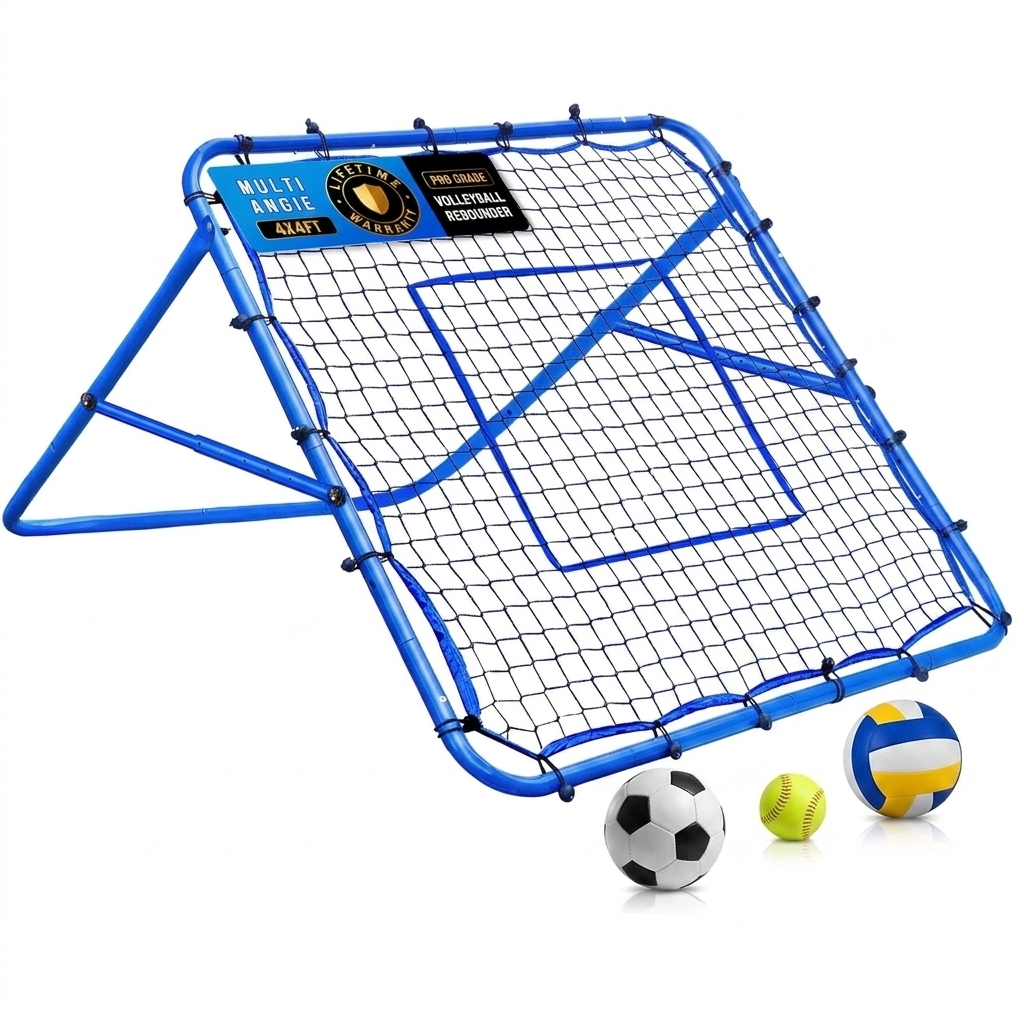
The Winthai is a compact 4 x 4 ft rebounder with six adjustable angles, a steel frame with PE net, and a target strap for accuracy work. Six angles is more than most rivals offer, and the target strap turns loose reps into focused passing practice.
For volleyball it handles passing and serving drills well and sharpens reaction time; then it crosses over to other sports without complaint. The smaller surface and softer return mean it is not a power-spiking tool — it is a skill-and-reaction trainer, and a good one.
Key Features
- 4×4 ft compact design
- 6 adjustable angles
- Steel frame + PE net
- Target strap for accuracy
Best For: Best for multi-sport households and players focused on passing accuracy and reactions.
Our Verdict: The multi-sport pick — six angles and a target strap for precision.
- Multi-sport use
- Adjustable angles
- Easy setup
- Smaller size
- Less power for spikes
9. Newbyinn Volleyball Rebounder — Best for Young Players

The Newbyinn keeps things simple for new players: adjustable angles, a strong steel frame and a large rebound surface that forgives beginner mistakes. Assembly is easy, and the bounce-back stays consistent for setting, passing and serving basics.
It is a basic design — no premium extras, and heavy spikes are beyond it — but that is the right trade for kids and beginners who need reliable daily reps and good value while they learn.
Key Features
- Adjustable angles
- Strong steel frame
- Large rebound surface
- Multi-sport support
Best For: Best for kids, beginners and families who want simple, reliable solo practice.
Our Verdict: The young-player pick — forgiving surface, friendly price.
- Beginner-friendly
- Durable
- Good value
- Not for heavy spikes
- Basic design
10. WARMOUNTS 2-in-1 Rebounder Net — Best 2-in-1 Versatility

The WARMOUNTS does something unique here: it converts between a 7 x 5 ft and a 4 x 5 ft setup, with five adjustable angles, a strong steel frame, sandbags for stability and a high-elastic net. Big mode for power training, small mode for precision — one purchase, two rebounders.
Stability is a strength (the sandbags earn their keep on hard hits), and it serves beginners and advanced players equally well. Setup is slightly more complex and it is heavier than single-size rivals — the price of the flexibility.
Key Features
- 2-in-1 size (7×5 ft & 4×5 ft)
- 5 adjustable angles
- Strong steel frame + sandbags
- High-elastic net
Best For: Best for players who want one rebounder that adapts from precision drills to power training.
Our Verdict: The 2-in-1 pick — two sizes, five angles, rock-solid.
- Dual size design
- Strong stability
- Versatile use
- Slightly complex setup
- Heavier than others
11. Suteck Volleyball Rebounder Net — Best Durability

The Suteck is built for players who train hard and often: a full 7 x 4 ft surface, five adjustable angles, a heavy-duty steel frame — and spare net in the box, which quietly doubles the product’s working life
Powerful spikes do not cost it tension, and the strong rebound keeps high-tempo drills honest. It is heavier and pricier than casual models; that is the durability tax, and frequent trainers will gladly pay it.
Key Features
- 7×4 ft size
- 5 adjustable angles
- Extra spare net included
- Heavy-duty steel frame
Best For: Best for serious players who train several times a week and want gear that lasts.
Our Verdict: The durability pick — heavy-duty frame, spare net included.
- Very durable
- Extra net included
- Strong rebound
- Heavier
- Higher price
12. Oswerpon Volleyball Rebounder Net — Best for Heavy Use

The Oswerpon is the club-and-school choice: two high-quality nets included, five adjustable angles, a steel frame stabilized with sandbags and stakes, and high-tension elastic cords for a strong, consistent rebound.
It is built for long sessions and repeated daily use by multiple players — exactly the life that kills lighter rebounders. It takes space and is not a portable pick, but as a fixed training station for teams, it is the heavy-use answer.
Key Features
- 2 high-quality nets included
- 5 adjustable angles
- Steel frame with sandbags & stakes
- High-tension elastic cords
Best For: Best for schools, clubs and teams that need a rebounder surviving daily group use.
Our Verdict: The heavy-use pick — twin nets, sandbag stability, team-tough.
- Built for heavy use
- Stable setup
- Strong rebound
- Takes space
13. BAGAIL Volleyball Rebounder Net — Best Value Kit

The BAGAIL is the complete-kit value play: a 28 sq ft practice area (about 7 x 4 ft), five adjustable angles, a durable HDPE net on elastic cords, a rust-resistant steel frame with ground stakes — plus a target strap and accessories in the box.
Returns stay consistent for spikes, serves and passing, the angles simulate real-game situations, and the frame stays planted during intense practice. It takes space and is not the most portable option here, but for beginners-to-intermediate players who want everything in one purchase, nothing beats its completeness for the price.
Key Features
- 5 adjustable angles for different drills
- Durable HDPE net with elastic cords
- Rust-resistant steel frame with ground stakes
- 28 sq ft practice area
- Complete kit with target strap and accessories
Best For: Best for players who want a complete, ready-to-train kit at a value price.
Our Verdict: The value-kit pick — everything included, nothing extra to buy.
- Complete training kit
- Adjustable angles
- Durable and stable
- Easy setup
- Takes space
- Not the most portable
- Setup may take time for first use
14. SKLZ Volleyball Rebounder — Best for Solo Training

SKLZ is the established training-equipment name on this list, and its rebounder shows why: premium materials, multi-angle adjustment and strong, consistent rebound tension that holds up to daily, high-level training.
It supports the full skill range — defense to attack — with a reliability casual brands rarely match. The costs are real: it is expensive, and assembly may need extra tools. For serious athletes who train alone most days, it is the professional-grade choice.
Key Features
- Premium build with durable materials
- Multi-angle adjustment
- Strong rebound tension
- Suitable for high-level training
Best For: Best for advanced and competitive players who train solo at a high level.
Our Verdict: The pro solo pick — premium build, trusted brand, daily-driver tension.
- Multi-skill functionality
- Reliable for daily training
- High-quality materials
- Trusted brand for sports equipment
- Expensive
- Assembly may require extra tools
15. Ovanto Spike Solo Trainer — Best for Spiking

The Ovanto is the specialist: not a general rebounder but a spike trainer, with adjustable height and a compact frame that holds the ball for approach, timing and arm-swing reps — no setter required.
Outside hitters use it to stack hundreds of quality swings in a single session, which is exactly how spike power and consistency get built. It does one job — it will not train your passing — but it does that job better than any general rebounder here.
Key Features
- Designed specifically for spiking drills
- Adjustable height for different players
- Compact frame with durable net
- Easy to transport
Best For: Best for hitters who want high-rep spiking practice on their own schedule.
Our Verdict: The spiking pick — endless approach-and-swing reps, solo.
- Easy to set up
- Lightweight and portable
- Height-adjustable
- Excellent for hitting practice
- Smaller frame compared to all-around rebounders
- Limited to spiking drills
How to Choose the Best Volleyball Rebounder
The right rebounder depends on what you train, where you train, and how hard you hit. Six factors decide it:
1. Training Purpose
Multi-angle rebounders like the Olybeaka, SKLZ and Aceletiqs train all-round skills — passing, setting, serving and defense. A specialist spike trainer like the Ovanto builds hitting power and timing but does nothing for your passing. Buy for the skill you actually need to fix.
2. Size and Surface Area
The most-asked question: what size rebounder is best? For most volleyball players, 7 x 4 ft is the sweet spot — big enough for realistic returns, small enough for a backyard. Choose 4 x 4 ft (or the compact 3 x 3 ft Seenelling) for small spaces and accuracy-focused work. Bigger surfaces forgive beginners; smaller surfaces sharpen advanced players.
3. Adjustability
Adjustable angles change the drill completely — flat for passing, steep for setting, varied for defense. Three angles is the minimum useful range; five or six angles (Winthai, ZVFOTN, Suteck) give the most variety. Fixed-angle models are cheaper but one-dimensional.
4. Durability and Frame Material
Steel frames with anti-rust coating survive outdoor life, while high-tension PE netting and elastic cords decide rebound quality. If you spike hard or train daily, prioritize frame weight and net tension over price — the Suteck and Oswerpon exist for exactly this.
5. Portability and Storage
Training at home only? A heavier, stable unit is fine. Moving between garden, park and gym? Weight, folding frames and a carry bag matter — the Kixer, Aceletiqs and Seenelling are the travelers on this list.
6. Budget
Rebounders range from budget picks under $80 (Kixer, Seenelling, Franklin territory) to premium models over $200 (SKLZ class). Cheap is fine for beginners; serious daily trainers should buy once at the higher tier instead of twice at the lower one.
Solo Training Drills You Can Do With a Rebounder
Passing ladder: Set a mid angle. Pass against the rebounder, control the return, repeat — 3 sets of 20 clean platform passes. Move one step back after every set.
Setting reps: Use a steep angle. Set into the net so the ball drops back into your hands, chasing soft, high hands and identical contact on every rep. Fifty in a row is the benchmark.
Serve and receive: With a flat angle, stand 6-8 ft back, serve into the rebounder and play your own serve’s return — the closest solo version of a real rally.
Digging reaction drill: Set a low angle and hit down-balls into the net from close range, then dig the rebound. Start slow — the rebounder always wins the speed war at first. Digging drills are kinder on your knees with a good pair of pads; see our guide to the best volleyball knee pads.
Spike approach work: With an Ovanto or a full-size rebounder at a high angle, work approach footwork and arm swing in sets of 10 — technique first, power second.
Drills only transfer to matches if your game-day setup is right too — our guide to the best outdoor volleyball nets covers the nets these skills get tested over.
Frequently Asked Questions About Volleyball Rebounders
What is a volleyball rebounder used for?
A rebounder helps you practice passing, setting, serving and spiking without a partner. The ball hits the tensioned net and bounces back, so you can repeat drills solo, at home, on your own schedule.
What size rebounder is best for volleyball?
For most players, 7 x 4 ft — large enough for realistic returns and all drill types, without taking over the yard. Smaller 4 x 4 ft or 3 x 3 ft models suit tight spaces and accuracy training; beginners benefit from the biggest surface they have room for.
Can beginners use a volleyball rebounder?
Yes — rebounders are ideal for beginners, because fundamentals improve fastest with high repetition, and a rebounder gives unlimited reps at home. Start with a larger, forgiving surface like the Franklin or Newbyinn and a mid angle.
Are rebounders only for spiking practice?
No. Most rebounders train the full skill set — passing, setting, serving and defense — by changing the net angle. Only specialist tools like the Ovanto Spike Solo Trainer are spiking-only.
How much does a good volleyball rebounder cost?
Expect roughly $60-$300 depending on size, angles and build. Budget models handle casual and beginner training well; competitive players who train daily should budget for the durable, full-size tier.
Can I use a volleyball rebounder indoors?
Yes, if you have the ceiling height and floor space — garages and gyms work well. Use a softer ball or lower intensity near walls, and choose a model with rubber feet or sandbag stability so it does not slide or tip.
What is the difference between a rebounder, a bounce back net and a return net?
Nothing — they are different names for the same tool. “Volleyball bounce back net”, “rebound net” and “return net” all describe a tensioned net that sends the ball back to you for solo practice.
Final Verdict: Which Volleyball Rebounder Should You Buy?
For most players, the ZVFOTN is the buy — full-size, five angles and match-realistic reps. The best adjustable all-rounder is the Aceletiqs. On a tight budget, choose the Kixer, or the Seenelling if accuracy-focused solo work is your goal. Serious solo trainers should step up to the SKLZ, hitters to the Ovanto, and teams and clubs to the Oswerpon. Whichever you choose, remember that a rebounder only pays off with reps — twenty focused minutes a day will improve your game more than any upgrade on this list.